🌕 AWAKEN
Two layers are yours now, the picture and the meaning. Tonight you learn the card's address, its place in the whole system. This is the layer that turns single cards into a map. Once you see where a card sits, you start to see why it means what it means.
Where Death actually sits in the story of the deck
The two cards standing right next to it, and why that matters
The number hiding a small secret about this card
🃏 CARD
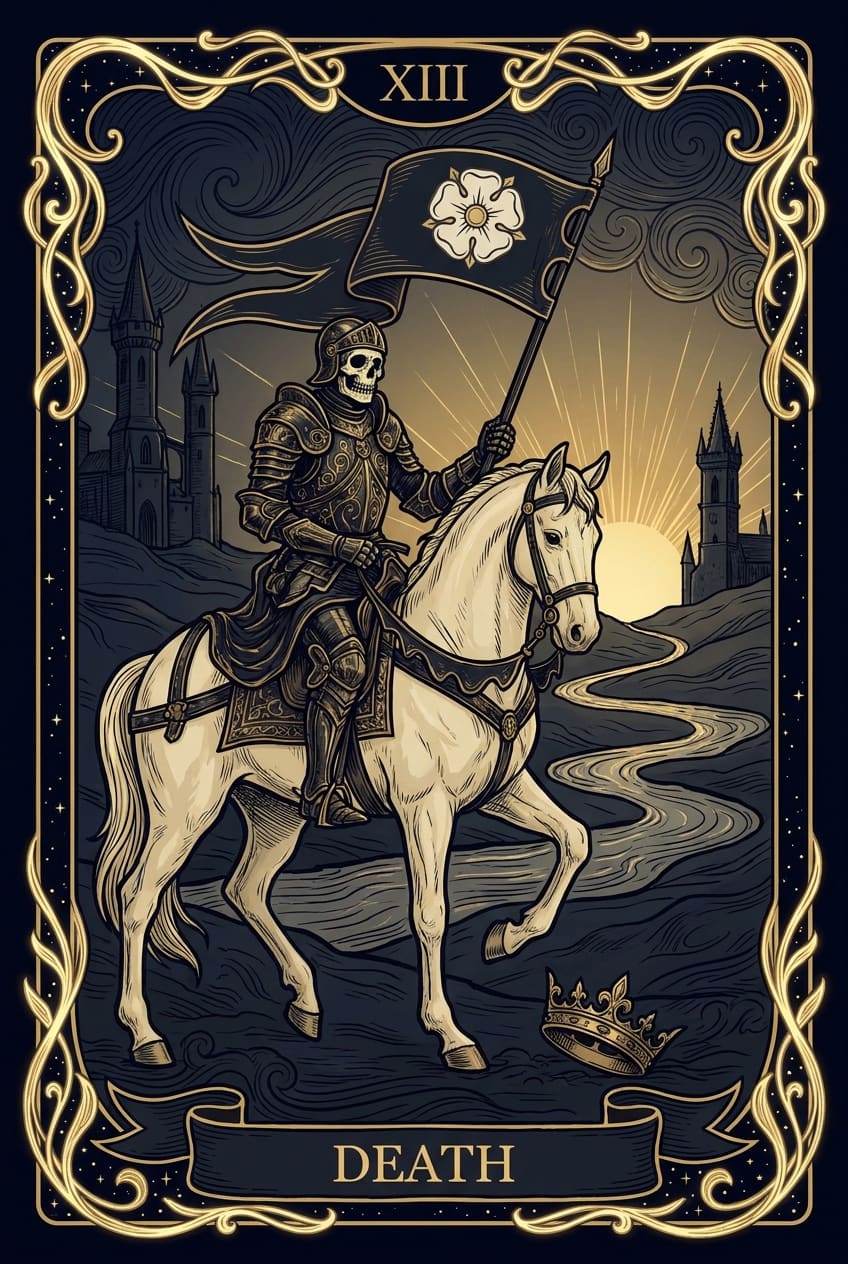
Today's layer is structure. Where does this card live, and who stands beside it?
🪟 STEPPING OUT
More free reads, on the house.
We teamed up with a few brands to bring you something extra: a short list of genuinely great newsletters.
Every one is free, and every one actually sends emails worth opening.
Help yourself. 🌙
🌖 SEE
Every Major Arcana card is numbered for a reason. The number is not decoration. It marks a stop along a longer story called the Fool's Journey, one long walk from innocence to wisdom, told across all twenty two Major cards.
Death is number thirteen. Thirteen sits almost exactly at the story's midpoint. That placement is not an accident. By card thirteen, the Fool has already met love, conflict, justice, and hard lessons. Death marks the moment the old self finally has to be set down, so the second half of the journey can begin with room to grow.
Here is the technique that makes number-reading useful anywhere in the deck. Low numbers, like one through four, are usually about beginnings and first choices. Middle numbers, like ten through fourteen, are usually about turning points, moments where the whole direction of the story shifts. High numbers, seventeen through twenty one, are usually about final understanding. Learn this range once, and you can guess roughly what any Major card is doing in the story just from its number, even before you know its meaning.
Now look at Death's neighbors, the cards standing directly beside it in the sequence. Before Death comes the Hanged Man, card twelve, a figure paused, seeing things from an upside down view, waiting. After Death comes Temperance, card fourteen, an angel calmly blending two cups of water into one. Read those three in a row and a pattern appears. Pause, then ending, then blending. The Hanged Man stops you and makes you look again. Death then clears out what that pause revealed was no longer working. Temperance follows to slowly mix the new pieces into something balanced.
This is the real skill of place-reading. A card's neighbors tell you what came before it emotionally, and what it is quietly setting up. Death is never the end of the story. It is the hinge in the middle, where letting go turns into blending something new.
🌗 SPEAK
Bring back everything, the picture, the meaning, and now the place. In your own words, tell me where this card sits in the deck, what comes right before it, and what comes right after.
🌘 JOURNEY
You know the middle of something hard, the part before it makes sense yet. Maybe you are there now, past the start, not yet at the calm after. That in-between spot is exactly where this card lives. Nothing about the middle of a hard stretch means it will stay hard. The story keeps moving, and something steadier is already on its way toward you.
🌑 QUICK ONE
Which card comes right after Death in the Major Arcana?
a) The Hanged Man
b) The Devil
c) Temperance
d) The Tower
💫 WITH LUNA
Tonight is the one to open Luna for. Lay Death next to the Hanged Man and Temperance inside the app, and watch the whole middle of the Fool's Journey click into place in a way no single card ever could on its own → luna.steady-spirit.com
✅ TRUTH
One way to read today's layer, not the only way: Death sits at card thirteen, near the middle of the Fool's Journey, right after the Hanged Man's pause and right before Temperance's calm blending.
Quick one: c) Temperance. It follows Death at card fourteen.
Tomorrow you put this card into a spread, and watch its neighbors bend it.
Read a new card with us every morning.